Temporera

Transkription auf Deutsch

English transcription
Audio completo en la voz de Karen Ravanales, Curimón
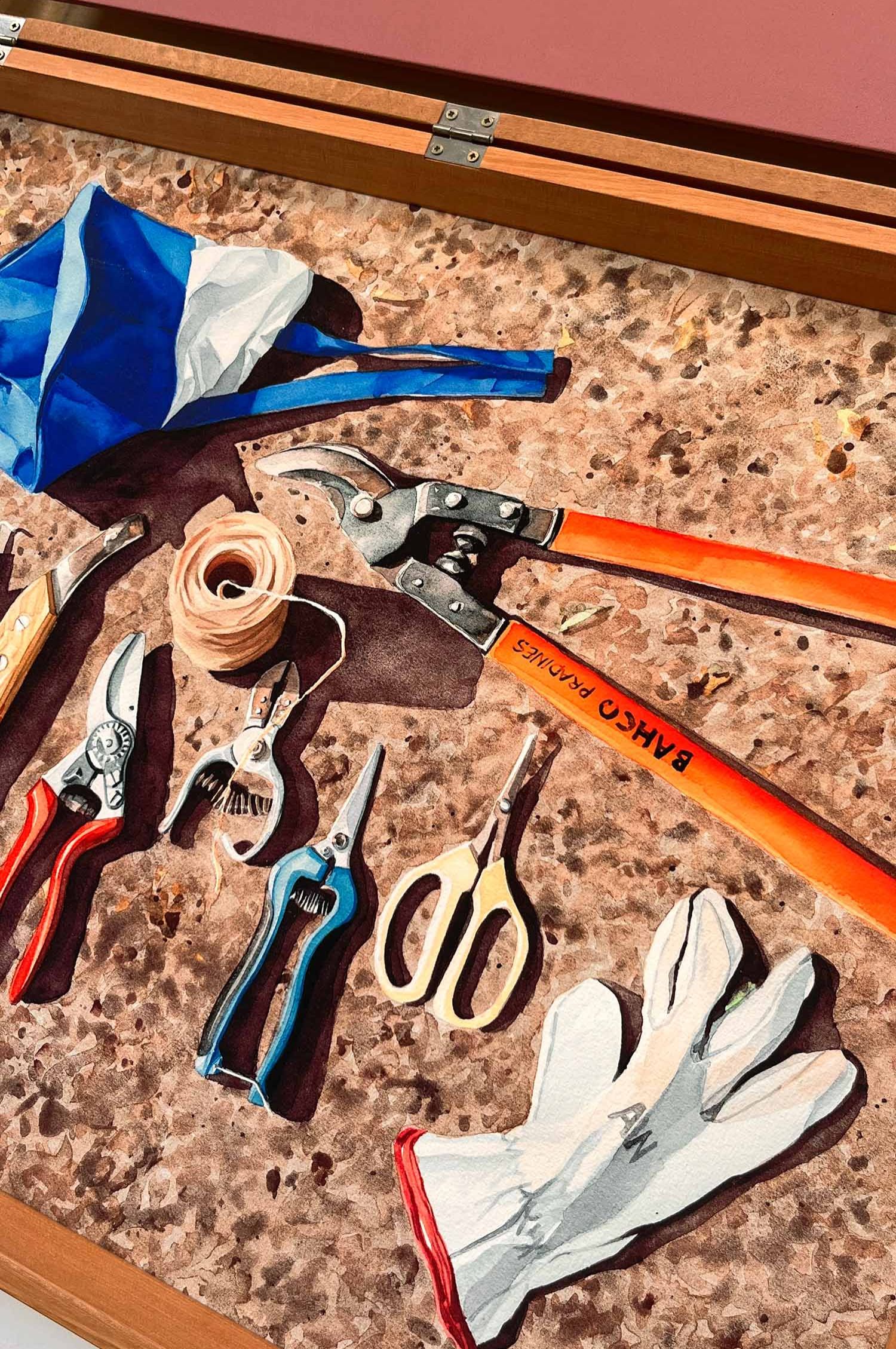
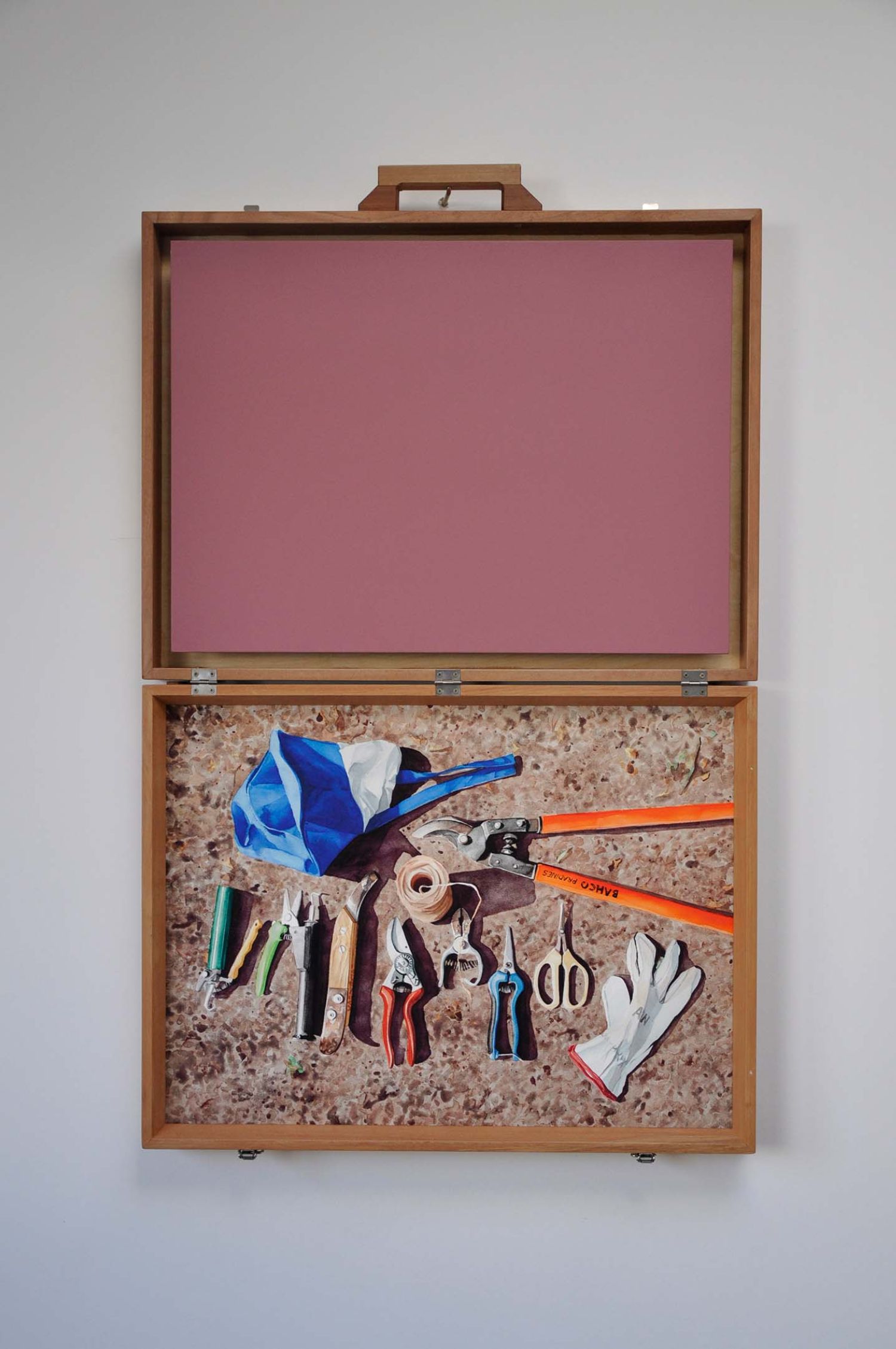
Maletín de madera con impresión Giclée (original en acuarela) y voz de Karen Ravanales, Curimón. Tamaño 61 x 47 x 10 cms.
LANDWIRTSCHAFTLICHE SAISONARBEITERIN
Nein, ich habe nicht studiert, weil ich bei meinen Großeltern aufgewachsen bin, habe ich nur meine Grundausbildung abgeschlossen. Eigentlich habe ich die auch nicht abgeschlossen. Also habe ich angefangen hier zu arbeiten. Im Alter von 11 Jahren habe ich angefangen zu arbeiten. Zuerst beim befestigen der Weinrebe, dann beim Jäten, an der Straße San Martín in einer kleinen Stadt namens El Bolsón. Eine Tante von mir nahm mich mit, um dort zu arbeiten, sie war auch landwirtschaftliche Saisonarbeiterin. Sie ist praktisch diejenige, die mich zusammen mit meiner Großmutter aufgezogen hat. Man nahm die Arbeit als Spiel oder um Geld zu haben, um sein eigenes Geld zu verdienen, um sich seine eigenen Sachen zu kaufen. Genau genommen war es eine Verpflichtung, denn ich lebte bei meinen Großeltern und hatte keine andere Wahl. Außerdem hatten meine Großeltern vier Enkelkinder großgezogen. Es war also so, dass man entweder arbeitet, um zu überleben, oder man bleibt einfach dort. Und ich wollte nicht weiter studieren.
Mit den Fortschritten wurden andere Fruchtsorten und Qualität hervorgebracht. Früher, in den alten Zeiten, arbeitete man auf dem Land und hatte nicht den Komfort wie heute. Früher musste man sein eigenes Wasser mitbringen, und wenn man kein Wasser mitgebracht hatte, hat man nichts getrunken. Heute wird alles auf die Station gebracht, es gibt Wasser, und es gibt Toiletten. Und viele Sorten sind verloren gegangen, denn als ich anfing zu arbeiten, gab es die Red, die Red Silver, die Empero, die gibt es alle nicht mehr. Es gab die Thompson, von der nur noch ein Sektor übrig ist. Weil diese Sorten neu sind, sind sie nicht so süß, sie sind frischer. Die Arra ist sehr geschmacklos. Die Great Green ist lecker. Hier ist die Great Green, da ist die Autumn, da ist noch ein Sektor Thompson. Die Ivory, die Thompson und die Great Green.
Nun, die Aufgaben sind sehr ähnlich, nur die Ausdünnung ist anders. Die Ausdünnung war bei der Thompson schwieriger. Es war also sehr zeitaufwendig, aber man bekam trotzdem schöne Früchte. Die Schultern der Rebe sind Arme und man hat immer die ersten 4 Schultern gezupft. Von dort aus hat man einen Ring gemacht und eine mit drei Armen gelassen. Darunter ließ man noch 3 kleine Arme und dann ließ man noch 3 Arme übrig und schnitt sie ab. Wenn die Traube zu reifen beginnt, beginnt sie zu platzen. Und wenn das passiert, erscheint die Botrytis, und wenn die Botrytis eintritt, sind wir aufgeschmissen.
Manchmal wird man als Ignorant behandelt, nur weil man keinen Abschluss hat. Aber ich sage, vielleicht habe ich kein Studium, aber ich habe die Praxis, ich habe so viele Jahre gearbeitet, dass ich die Jobs in- und auswendig kenne. Ich kenne dieses Landgut in- und auswendig. Viele von uns Arbeitern wollen, dass die Farm wieder so wird, wie sie früher war. Don Roberto kam immer donnerstags, wir haben samstags gearbeitet, weil er wollte, dass wir hier arbeiten. Denn ihm ging es um Qualität, nicht um Quantität. Er sagte immer: „Wenn ich keine Qualität habe, nützt mir die Quantität nichts, denn ich kann die Qualität zu einem besseren Preis verkaufen als die Quantität“.
Dann kommt das Beschneiden. Der Mann beschneidet, zieht Triebe und reinigt die Träger. Das Ziehen der Triebe ist, wo sie alles abmachen, was sie vom Träger genommen haben, was vom Träger übriggeblieben ist, nämlich ein langer Trieb. Und beim Reinigen des Trägers wird der ganze Abfall, der übriggeblieben ist, entfernt. Und dann binden wir. Früher haben wir Totora-Schilf benutzt, dann eine Zeit lang, ein schwarzes Plastikband. Ich weiß nicht, ob man dir eine Rolle gegeben hat von dem, was man heutzutage benutzt. Dann haben wir es mit einer Maschine gebunden, die eine blaue Rolle hatte, wie diese große. Und die hat man dann hier aufgehängt, an der Brust. Aber so groß. Dann kam Tania mit einer schwarzen Maschine, die man mit dem Faden benutzt, den Sie bekommen haben, die Pitilla.
Wenn man am neuen Träger nach 3 Trieben gefragt wird, muss man 3 Triebe mit Früchten zurücklassen. Denn wenn Sie einen Trieb ohne Früchte zurücklassen, nützt er nichts. Zum Beispiel kann der Träger bis zu 8 Triebe haben, und wenn man stutzt, haben sie praktisch schon Trauben, aber die sind so klein, dass man sie kaum sehen kann. Darauf muss man also achten, dass man die guten Knospen stehen lässt, und wenn man nach 3 gefragt wird, muss man 3 pro Träger lassen. Wenn man zum Beispiel zu viele Triebe lässt, nimmt das die Kraft von dem Trieb mit den Früchten der dann dünn bleibt.
Weil es keine Maschinen für diese Art von Obst gibt… zum Beispiel gibt es Maschinen für Walnussbäume. Warum? Weil es für den Walnussbaum eine Schüttelmaschine gibt, die die Nüsse aufsammelt, aber nicht für Trauben. Ich denke es braucht jemand sehr schlaues, um einen technologischen Fortschritt für die Arbeit auf dem Weinberg zu machen. Das Höchste, was ich gesehen habe, waren ein paar Scheren, die Batterie betrieben waren und aufgeladen wurden, um die Schnitte zu machen, aber man muss sie trotzdem in die Hand nehmen. Nein, diese Arbeiten können so nicht gemacht werden, nein. Wir werden das alles weiter benutzen, alles. Wir werden weiterhin all das, all das, all das benutzen.
SEASONAL FARMER
I got married when I was 15 years old, it was a strange story because for me it was like the way of leaving home, and the only solution was to get married because we were both minors. He was 16 when we got married, now he is 44. But I never gave up and we are still together, we have been together for 28 years and we both work here. He is a tractor driver.
No, I wasn’t studying at that time, because I was raised by my grandparents, so I just finished my basic education. I didn’t finish it either, really, I left it incomplete. And from there on I dedicated myself to working on this. I started working at the age of 11. Well, it was the mooring, and then the weeding, back there on the San Martín highway in a little town called El Bolsón. An aunt took me to work there, she was also a seasonal farmer. She is practically the one who raised me along with my grandmother. At that age one took work as a game or to have some money, to earn your own money, to buy your own things and in some way it was more of an obligation because living with one’s grandparents gave you no choice. Besides, my grandparents had already raised four grandchildren. So it was like say ing «you work to survive or you just stay there». And I didn’t want to continue studying.
It is as if with the technological advances they are bringing out another type of variety of fruit, quality and everything, because before, in the old days, you worked in the field and did not have the comforts that you have now. In the old days you had to bring your own water and if you didn’t have water, you just didn’t drink anything. Not now, now things are taken to you to the stand, there is water available, you have toilets. And many varieties have been lost because when I started working, you saw a lot of red grape, the Red Silver, the Empero, which is no longer there. You had Thompson grape, which is only grown in one barrack now. Because these varieties are new, they are not as sweet as the old ones, they are fresher. And the Arra is very tasteless, the one that is delicious is the Great Green. Nowadays we grow here the Great Green, the Autumn, there is just one Thompson barrack left, the Ivory and the Thimpson.
Well, the job you have to do is very similar, the only thing that changes is the thinning process. Thinning was more difficult with Thompson. The depilation was very slow, but the fruit you harvested was still beautiful. The shoulders are like the arms of the vine and one always had to depilate the first 4 shoulders. From there you would make a ring, leaving a floor of three. You would leave three little arms below, and then you would leave three more and cut it. As the grapes squeeze together, they begin to ripen and start to burst. And then botrytis begins to enter and when botrytis enters, we are dead.
Sometimes you are treated as ignorant, just because you don’t have the studies. But I say, maybe I don’t have the studies but I have the practice, I have worked so many years in this that I know the job backwards and forwards. I know this farm backwards and forwards. So there are many of us workers who want the farm to go back to the way it was in the old days. Don Roberto used to arrive on Thursdays, we worked here on Saturdays at that time, yes, because he liked us to be here working. He was interested in quality, not in quantity. He always said «if I don’t have quality, quantity is of no use to me, because I can sell quality at a better price than I can sell quantity».
Well, then comes the pruning. Normally man workers prune, they throw the guide and clean the loader. Throwing guides is when they take out everything they took out of the loader, what’s left from the loader which is a long guide. And cleaning the loader is to remove all the garbage, all the dirt that is left after the cuts. From there on, women can tie up. In the old days we used cattail, then for a while we used a black plastic tape. I don’t know if they gave you a roll of what we use now. Then we tied up with a machine that was like a big blue roll. And you put it here and hung it here on your chest. But this is big. Then Tania arrived with a black machine that is the one used with the thread that was given to you, the pitilla for tying. In the new loader, if you are asked for 3 sprouts, you have to leave 3 sprouts that have fruit. Because if you leave a shoot that has no fruit, it is of no use to you. For example, the loader can have up to 8 shoots, and if you are weeding, they practically already have bunches, but they are so small that you can hardly see them. So you have to pay attention to that, to leave a good shoot and if you are asked for 3, you have to leave 3 per loader. For example, if you leave too many shoots, you are taking away the one with the fruit to grow, it does not thicken up.
Because there are no machines to do this type… for example, there are machines you can use with walnut trees. Why, because the walnut tree has the shaker machine, it has the one that picks up the nut, but the grape doesn’t. I think that for vineyards it would need someone very intelligent who can invent a new technology to replace a job, but no. The most advanced thing I have seen were some scissors that appeared the other time that I saw, that were battery-loaded and they were charged to make the cuts, but you still had to operate them with your hands. No, this kind of job can’t be done like that, no. We are going to keep using all these tools, everything. We are going to continue using all this stuff, all this, all this.