Pintora

Transkription auf Deutsch

English transcription
Audio completo en la voz de Pilar Galilea, Ñuñoa
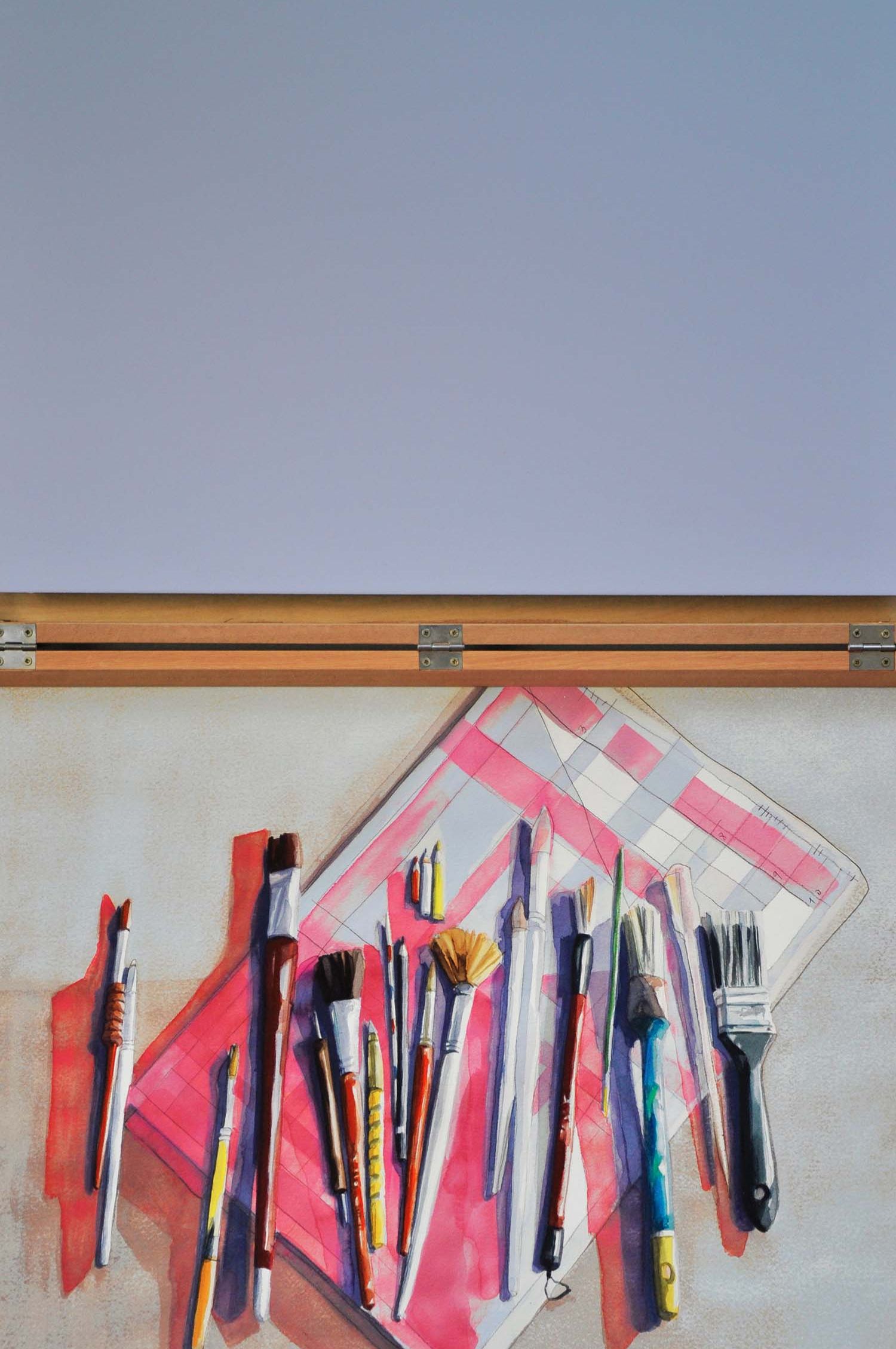
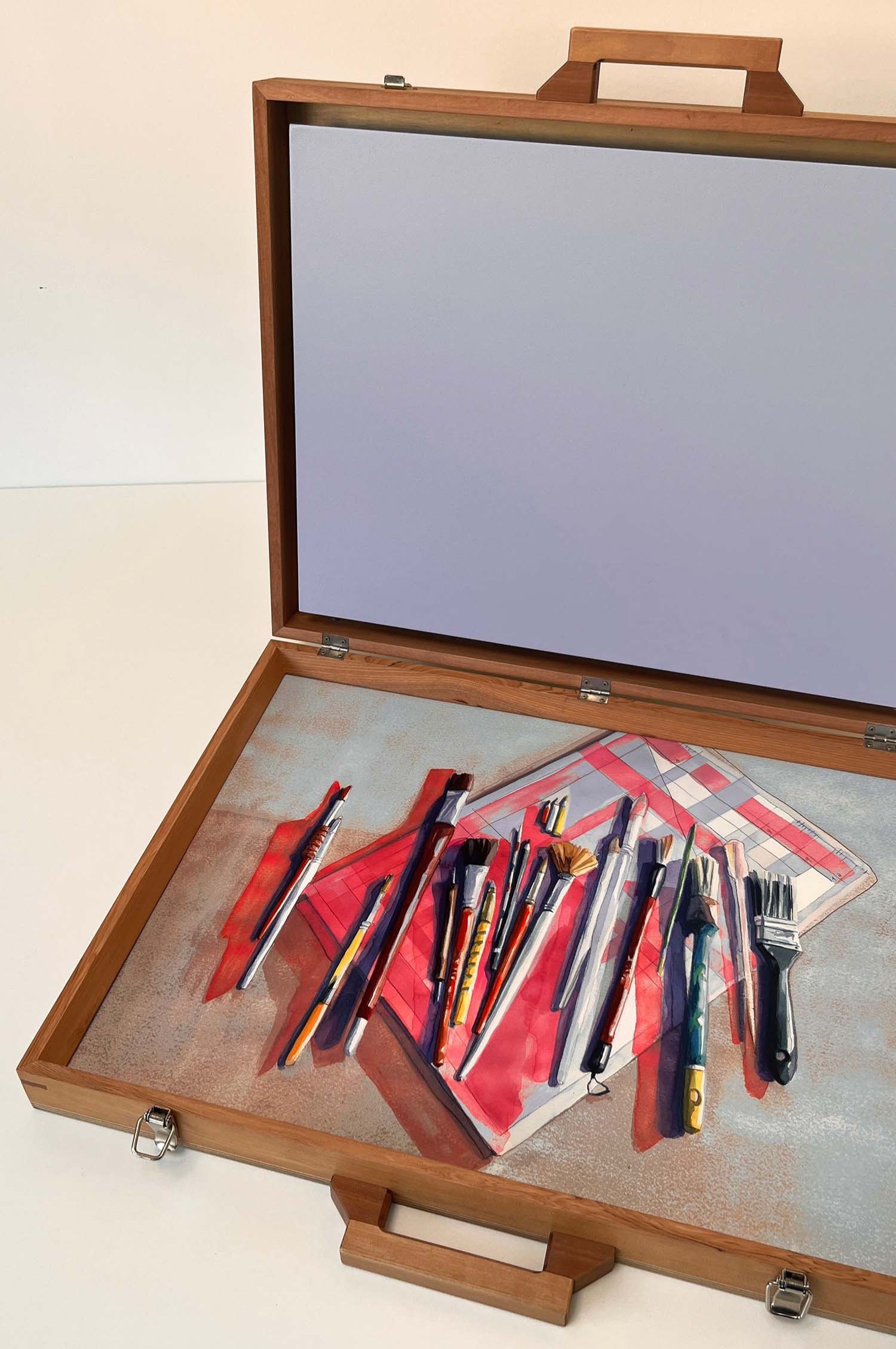
Maletín de madera con impresión Giclée (original en acuarela) y voz de Pilar Galilea, Ñuñoa. Tamaño 61 x 47 x 10 cms.
MALERIN
Papier hat eine bescheidene Würde, die mich berührt, auch wenn es widersprüchlich erscheint, wenn man bedenkt, dass es in China seit fast zweitausend Jahren zum Schreiben verwendet wird. Es ist ein leichtes Medium, aber es hat ein großes soziales Gewicht, denn es war grundlegend, um Ideen zu verbreiten und Wissen zu teilen. Ich weiß nicht, wissenschaftliche Entdeckungen, botanische Illustrationen, Karten, Poesie und Kunst. Es weckt in mir einen gewissen Respekt vor der Geschichte und vor all denen, die vor uns kamen. Wenn ich zum Beispiel an die Fresken denke, stelle ich mir vor, dass es eine sehr radikale Umstellung gewesen sein muss, die Wand und all die Heiligkeit des Statischen, Riesigen und sehr Dauerhaften zu verlassen, um auf Papier umzusteigen, das viel weniger großspurig ist, das im Allgemeinen in kleineren Formaten bearbeitet wird, das einem erlaubt, zu skizzieren, Fehler zu machen, in die Logik des tragbaren und des Unmittelbaren einzutauchen. Denn die Leinwand und der Rahmen haben für mich immer noch zu viel Formalität und einen Geruch nach Museum, so dass sie mich in gewisser Weise vom realen Leben trennen. Und natürlich ist es gut, dass es in der Welt des Papiers alles gibt, von diesen wunderbaren Blättern aus reiner, handgepresster Baumwolle bis hin zum gewöhnlichsten und alltäglichsten Notizbuch aus der Schule, und das ist schön, weil man am Ende sieht, dass Papier ein transversales Material ist, dass überall ist und dass es tausenden von verschiedenen Verwendungen standhält.
Ich habe eine Freundin, die die gleichen handwerklichen Techniken zur Herstellung von Aquarellfarben wieder aufgreift, wie sie im Mittelalter verwendet wurden. Sie sagt, dass die Farben aus der Erde kommen, dass sie hauptsächlich aus Steinen und Wasser bestehen, tatsächlich heißt so auch ihr Projekt. Und es ist wahr, denn einige natürliche Pigmente stammen aus Pflanzen, andere werden aus Lehm, aber hauptsächlich aus Mineralien hergestellt und am Ende ist alles sehr simpel, sehr edel und wie ursprünglich: es ist Papier… Farbe… und Wasser.
Was ist das Schwierigste daran? Ich denke, das Licht zu bewahren, ist die erste Herausforderung. Man muss die Form und den Raum völlig anders aufbauen, als man es gelernt hat mit matteren Materialien, wie Öl oder Acryl. Selbst bei der Gouache aus der Kindheit sammelt man das Pigment nur in einer Richtung an, vom dunkelsten zum hellsten. Bei Aquarellfarben hingegen beginnt man mit dem Weiß des Papiers und muss die hellen Stellen reservieren, damit sie nicht verschwinden. Mit den Transparenzen spielen, Schicht für Schicht, bis die letzten Details mit den dunkelsten Pinselstrichen das Bild fertig gestalten. Aber es gibt fast kein Zurück mehr, denn wenn man mit dem Farbton eines Flecks zu weit gegangen ist, dann bleibt es so. Der Prozess ist also sehr zen, denn er zwingt einen gewissermaßen dazu, in zwei Richtungen gleichzeitig zu denken. Die am Ende gleich wichtig sind, denn einerseits muss man sich um das Licht kümmern – und verstehen, dass diese Leere sehr prominent ist – und andererseits die Dunkelheit hinzufügen, wobei alle Töne dazwischen zu berücksichtigen sind.
Ich denke, das ist es, worum es bei der Aquarellmalerei geht, als Technik und zumindest für mich, die Fähigkeit, im Rhythmus des Wassers zu fließen und dieses fast millimetergenaue Gleichgewicht zu finden, bei dem man den Pinsel in seiner ganzen Natürlichkeit loslässt, aber dennoch eine gewisse Kontrolle behält, um dem Bild eine Form zu geben. Ich denke, das ist die große Herausforderung: zu lernen, das Wasser zu lenken und ihm gleichzeitig seine Autonomie zu lassen, so dass es seinen flüssigen Charakter nicht verliert. Zu verstehen, wie man ein Material, das von Natur aus frei und unberechenbar ist, so subtil wie möglich kanalisiert, denn Wasser ist ständig in Bewegung.
THE PAINTER
Besides, there is a humble nobility in the paper that moves me. Imagine that in China it was used to write on nearly 2.000 years ago. It is a light support but it has a lot of social thickness. It was fundamental to spread ideas and to share knowledge, scientific discoveries, botanical illustration, maps, poetry and Art. So it awakens inside me a sort of respect for History and for all people who came before us. If I think about the frescoes, for instance, I imagine it would have been a very radical change to quit the wall and that sacredness of the static, the enormous and the permanent, to start using paper which is much less grandiloquent. It is worked, generally, in smaller formats and this allows you to sketch, to make mistakes, to get into the logic of the portable and of the immediate reality. The canvas and the frame have still too much formality and museum smell, so in a way I fell that they are separated from real life. And of course in the paper world you find from those marvelous sheets made of pure cotton, pressed by hand, to the most common and the everyday paper used in school notebooks. This is nice because finally you realize that paper is a transversal material, it is everywhere and withstands thousands of different uses. I have a friend who recovers the same handicraft techniques of watercolor manufacturing used in the Middle Ages. She says that colors are born from the earth, that they are mostly stones and water. In fact, that is the name of her project. And it is true, because some natural pigments come out from plants, others are made from clays but they are mostly made out of minerals. Finally everything is simple, very noble and fundamental: paper…color…and water.
What is the most difficult thing? Mmmm. I think that to preserve light is the first challenge, because you have to build the form and space the other way around. The opposite as when you learned to paint with more opaque materials, such as oil or acrylic. Even with the gouache paint that you used during childhood you were accumulating pigment in solely one direction, from the darkest to the lightest areas. In watercolor, on the contrary, you start from the white of paper and from the beginning you have to lay aside the light sectors so that they don´t disappear. You have to play with transparencies, layer by layer, until you give the last details with the darkest brushstrokes which complete the shape of the image. And there is almost no turning back, if you made a mistake in the tone of a paint stroke that is how it will stay. So, the process is quite Zen because it forces you to think in two directions of equal importance simultaneously: on one hand you have to take care of the light- and to understand the protagonism of that emptiness- and on the other hand you add darkness, respecting all the shades which are in between.
Until now I think that is what watercolor is mostly about, as a technique for me at least: To be able to flow with the rhythm of the water and to find this balance, almost millimetric, where the brush is released in all its spontaneity but you still preserve some control for being able to give form to the image. I think that this is the greatest challenge, to learn how to guide the water and leave it to preserve its autonomy at the same time; that it doesn´t lose its fluid nature, to understand how a material which is intrinsically free and unpredictable can be guided as subtly as possible. Cause in the end, water is in constant motion.