Cocinero

Transkription auf Deutsch

English transcription
Audio completo en la voz de Manuel Subercaseaux, Valparaíso y Cochamó

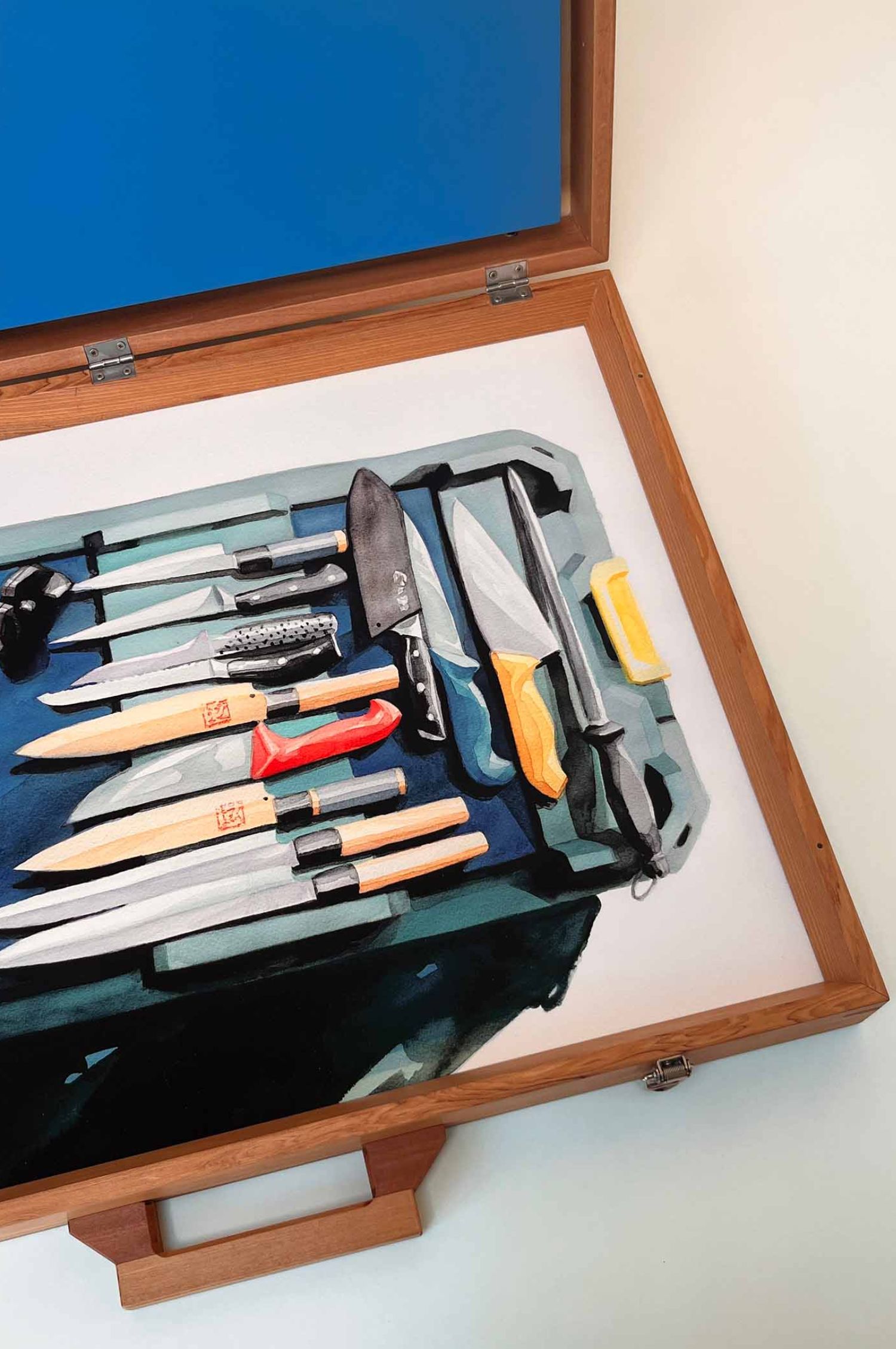
Maletín de madera con impresión Giclée (original en acuarela) y voz de Manuel Subercaseaux, Valparaíso y Cochamó. Tamaño 61 x 47 x 10 cms.
KOCH
Da, das sind sie. Arrangiert wie eine große Familie, aber innerhalb dieser großen Familie gibt es einige, für die ich mehr Zuneigung, mehr Respekt, mehr Wertschätzung empfinde und die ich häufiger benutze. Unter diesen Messer gibt eins, das mich seit 14 oder 15 Jahren begleitet. Es ist ein Filetiermesser, das ich zum Filetieren von Fisch benutze und das sich sehr abnutzt, weil das Filetieren ein sehr harter Prozess ist. Das Messer wird auf die Probe gestellt, die Schneide an den Gräten. Es geht gut durch aber uff! Das Messer leidet sehr. Man muss es immer wieder schärfen, also nutzt sich die Schneide und die Klinge ab. Das Messer verändert sich dadurch, und abhängig davon, wie man es schärft, nimmt die Klinge eine andere Form an. In meinem Fall, wenn man es so sehr schärft, sieht es fast wie eine Ahle aus. Die Spitze ist sehr, sehr fein. Es ist ein Messer, vor dem ich großen Respekt habe, weil ich das Gefühl habe, dass das Messer mit der Zeit unkontrollierbarer wird. Es ist eiine Herausforderung, denn es ist schwieriger, es zu handhaben. Man muss auch sehr vorsichtig sein, denn plötzlich rutscht die Spitze ab und man schneidet sich sehr schnell. Außerdem ist es das Messer, was ich am meisten benutze und welches am längsten hält. Für mich ist es fundamental, es ist ein Messer, das immer leistet. Aber es erfordert Arbeit, damit es funktioniert. Es muss jedes Mal sehr gut geschärft werden, deshalb ist es mein Lieblingsmesser.
Warum das Meer? Nun, wenn man in Chile lebt, ist das Meer in immer in unserer Nähe. Obwohl ich glaube, dass es kulinarisch gesehen nicht ganz so ist. Es ist eine unerschöpfliche Quelle von Ressourcen, d.h. Fisch, Meeresfrüchte, Algen, es ist völlig unerschöpflich. Und es ist eine Ressource, die wirklich mehr Persönlichkeit hat. Sie ist lebendiger, wenn sie uns erreicht, viel lebendiger als Rind- oder Schweinefleisch. Und das hat eine unglaubliche Wirkung auf einen Koch, weil es ein sehr edles Produkt ist, und wenn man ein gutes Produkt bekommt, muss man es nur ein wenig würzen, es gibt nicht viel zu tun. Es ist unbeschreiblich, was mit dir als Koch passiert, wenn du einen Fisch fängst, einen frischen Fisch filetierst und diesen Kontakt mit dem Produkt hast, das so lebendig ist, dass auf einer sensorischen Ebene unglaubliche Sachen passieren. Dein Kopf beginnt auf eine andere Art und Weise zu arbeiten, wenn es darum geht, wie man einem Gericht durch dieses Produkt Leben verleiht. Hinzu kommt, dass ich in meinem Beruf als Koch immer in der Nähe des Meeres gearbeitet habe, sowohl in Valparaíso über zwanzig Jahren als auch jetzt im Süden Chiles, wo ich an einer Flussmündung lebe, die sowohl Süß- als auch Salzwasser enthält. In diesem Sinne glaube ich, dass das Territorium auch eine Präsenz darstellt.
Sich so leidenschaftlich der Arbeit mit Meeresfrüchten zu widmen, hat in diesem Land eine gewisse Komplexität, denn ich habe das Gefühl, dass die Menschen viel Fleisch, viel Reis, viel Pasta, viele Kohlenhydrate essen. Ich sage oft, dass ich das Gefühl habe, dass wir dem Meer den Rücken kehren. Ich schließe mich selbst mit ein, obwohl ich auch versuche, ein wenig von der maritimen Speisekammer die wir haben, zu retten. Aber nichtsdestotrotz denke ich, dass es ein interessanter Weg ist, es ist auch ein langer Weg. In gewisser Weise geht es darum, den Gaumen ein wenig umzuerziehen, und zwar nicht nur mit Produkten aus dem Meer, sondern auch mit Dingen, die noch tiefer verwurzelt sind wie die Küche der Ureinwohner, die Küche der Mapuche. In Patagonien gibt es immer noch viele Traditionen, die noch nicht verloren gegangen sind, aber mit den Jahren verblassen sie natürlich in gewisser Weise. Ich denke, dass die Teilnahme an dieser kulinarischen Rettungsaktion dem Leben, oder meinem Leben, ein wenig Sinn verleiht.
Früher war es im Süden Tradition, in der Nähe des Holzofens zu sein, um den Prozess des Kochens, Schlachtens, Ackerns, Erntens physisch zu umgeben. Nun, im Norden auch, aber Ich weiß nicht, warum ich es mir mehr im Süden vorstelle: das Feuer, das Holz, der Schornstein, der Rauch, der herauskommt. Es ist eher ein Ritual. Es war eindeutig mehr mit den Frauen verbunden. Ich habe einige Bekannte, die in den Bergen aufgewachsen sind – im Paso del León, der wirklich nur einen Katzensprung von Argentinien entfernt ist, eigentlich weiter weg von Chile – und sie haben mir erzählt, dass ihre Großmütter und Tanten die ganze Arbeit des Kochens gemacht haben. Sogar den Ackerbau, weil dort nichts hinkam. Was mich erstaunte war, dass sie große Raucherinnen waren. Sie besorgten große Pakete Tabak und diese Großmütter und Tanten rauchten den ganzen Tag lang Zigarren. Ich stellte mir diese großartigen Frauen vor, stark, rauchend, fast wie die Popeyes der Küche. Ich fand es genial. Das ist verloren gegangen, dieses Ritual in der Küche, dort zu sein, die Gerüche zu spüren. Jetzt geht alles viel schneller. Ich weiß nicht, ich bestelle Essen und das Essen kommt. Ganz zu schweigen von dem Thema Anbau. Es gibt auch eine Mode, anzubauen und ernten. Eine Mischung aus Mode und Gesundheit. Aber gut, es gibt da einen Konflikt. Und nichtsdestotrotz denke ich, dass es sehr schön wäre, wenn man die Menschen ein wenig mehr mit diesem Prozess in Verbindung bringen könnte. Dass die Leute hingehen und anbauen können oder es Orte gäbe mit Gärten oder Gewächshäuser, wo die Leute gucken können. Auch für Kinder wäre es ein viel lehrreicherer Prozess. Es würde bedeuten, sie an der gesamten Erfahrung teilhaben zu lassen, vom Anbau über bis hin zum Kochen, Probieren und Verkosten. Aber dafür müsste man etwa 5 Stunden für ein Mittagessen einplanen.
Wenn du mich fragst, was ich fühle, ist die Wahrheit, dass ich mir nicht viel bewusst bin. Ich könnte nicht aufzählen, was ich fühle oder wie ich es fühle, ich denke, es ist, als würde ich in einen Tunnel eintreten. Die Dinge passieren, sie geschehen, sie entwickeln sich während man kocht. Natürlich denkt man ständig nach, stellt sich etwas vor, und es gibt andere Dinge, die auf völlig unerwartete Weise in deinem Kopf erscheinen. Sie sind wie Blitze, wie Sterne, die auftauchen. Und das macht auch den kreativen Prozess sehr interessant. Natürlich denkt man, na ja, ich kann dieses mit jenem mischen, und dann im Prozess selbst ist es nicht so gut. Aber Übung macht den Meister, wie man sagt, und so kann man auch Mischungen und Gerüche schmecken und sich vorstellen, sie visualisieren. Mehr als alles andere ist es immer aufmerksam auf alles zu sein, auf das, was dich umgibt, auf deine Träume, Dinge erscheinen in deinen Träumen. Man muss also immer aufmerksam sein und versuchen, auf diese Reize zu reagieren.
THE COOK
There they are, those are the ones. Arranged like a big family, but within that big family there are some of them that I have more affection for, more respect, more appreciation for and that I use more often. I think that within the list of those knives there is a knife that has been with me for 14 or 15 years. It is a filleting knife that I use for filleting fish that wears out a lot because the process of filleting is a very hard process. The knife is tested, because the edge suffers with the bones. Poof! The knife has a very hard time. So it is necessary to sharpen it continuously and then the edge wears out along the road, the blade does, so it’s like the knife transforms itself during the process and as you sharpen it, depending on the way you sharpen it, the blade will take on a different shape and, in my case, as I sharpen it so much, it almost get to look like an awl. The tip is very, very fine. And it’s a knife that I have a lot of respect for because I also feel that as time goes by the knife becomes more uncontrollable, it’s more difficult for me to handle it, which is a challenge. And you also have to be very careful because suddenly the tip slips off and you can cut yourself very quickly. And it’s also the one I use the most, it’s the one that is more filled with life. For me it’s fundamental, it’s a knife that always responds to me. But it requires work to make it work properly, it requires a very good sharpening every time, so for that reason it’s my favourite knife.
Why the sea? Well, living in Chile, the truth is that the sea is always by our side. Although I feel that culinarily speaking it is not quite like that. But it is an enormous source of resources, you have fish, seafood, seaweed, it is completely inexhaustible. And it is a resource that has really more personality, it is more alive when it reaches our table, much more alive than beef or pork are at that point. And this has an incredible effect on a chef because it is a very noble product that reaches your hand, and when you get a good product, the truth is that the only thing you need to do is bathing it with a little flavour, there is not much to do. It is undescribable what happens to you as a chef when you grab a fish, you go to fillet a fresh fish and you have that direct contact with the product so alive. Incredible things happen to you at sensory levels and also your head starts to work in another way in terms of how to give life to a dish through this kind of product. Besides, my profession as a chef has always developed close to the sea, both in Valparaíso for twenty-something years and now in the south of Chile, where I live next to an estuary that has both fresh and salt water at the same time. So in that sense I think that the territory also gives a deep presence in what you cook.
Now to dedicate oneself so passionately to work with seafood has a certain complexity in this country, because I feel that people eat a lot of meat, a lot of rice, a lot of pasta, a lot of carbohydrates. And in a way, which is like a typical phrase of mine, I feel that we turn our backs on the sea. I include myself too, even if I feel that I am working on the other side trying to rescue a little bit of the maritime pantry that we have. But anyway, I think it’s an interesting road to go through, it’s a long road too. In a way it is trying to re-educate a little the palate, and not only regarding seafood but also in relation to things that are even more deeply rooted, such as the cuisine of the native people, Mapuche food for example. In Patagonia there are still many traditions that have not yet been lost, but clearly as the years go by they are disappearing in some way. And well, I think that participating in this culinary rescue crusade gives a bit of meaning to life, to my life.
In the old days -in the south- it was a tradition to be close to the wood cooker, to surround the process of cooking, of slaughtering meat, of cultivating vegetables, harvesting. Well, in the north too, but I don’t know why I visualize it more in the south: the fire, the wood, the chimney, the smoke coming out of the roof. It was more like a ritual. It was clearly more linked to women. In fact, I have some acquaintances who grew up here in the mountains -in Paso del León, which is really only a stone’s throw away from Argentina, almost further than from Chile- and they told me that their grandmothers or aunts were obviously the ones who did all the cooking. From what was grown, because no food arrived there, and what amazed me was that they told me that they were great smokers. They would get big packets of tobacco and these grandmothers and aunts would be smoking Havana cigars all day long, so I imagined this picture of these big, strong women, smoking, almost like some Popeyes in the kitchen. I think it´s a great image anyway. That beautiful thing has been lost, that ritual of the kitchen, of being really there with your senses awakened, of feeling the smells. Now it’s all much quicker, I don’t know, I ask for food and food arrives, not to mention the issue of growing anything. Because there is also a bit of a new fashion for growing, for harvesting, it’s between fashion and health care. But well, there’s still a battle there. And well, I think it would also be very nice to be able to connect people a bit more with this process. From people that could go and grow crops directly or maybe there could be places that have their own gardens or greenhouses where other people could come and see. Or maybe children too! It would be a much more educational process. It would make them participants of the whole experience, from growing, cooking, tasting, trying something new…but for doing that you would have to spend about 5 hours in a lunch.
If you ask me what I feel while I cook, the truth is that I don’t have much awareness of it. I couldn’t enumerate what I feel or how I feel it, I think it’s like entering a kind of time warp. Things happen, they just occur, they are naturally happening during the act of cooking. Clearly one is always thinking about it, imagining different combinations, but there are other things that pop up totally unexpectedly in your head. They are like flashes, like stars that appear. And that also makes the process of creation very interesting. Sometimes one can think, well, I can mix this with that but then in the process itself it is different, and sometimes it’s not as good as you imagined. But practice makes perfect, as they say, so at some point you are able to taste and imagine mixtures and smells in your head as well, you can visualize them. More than anything it deals with being constantly attentive to everything, to what surrounds you, to your dreams, to impressive things that appear in your dreams. So you always have to pay attention and try to react to these stimuli.