CIRUJANO

Transkription auf Deutsch

English transcription
Audio completo en la voz de Sebastián Villegas, San Miguel
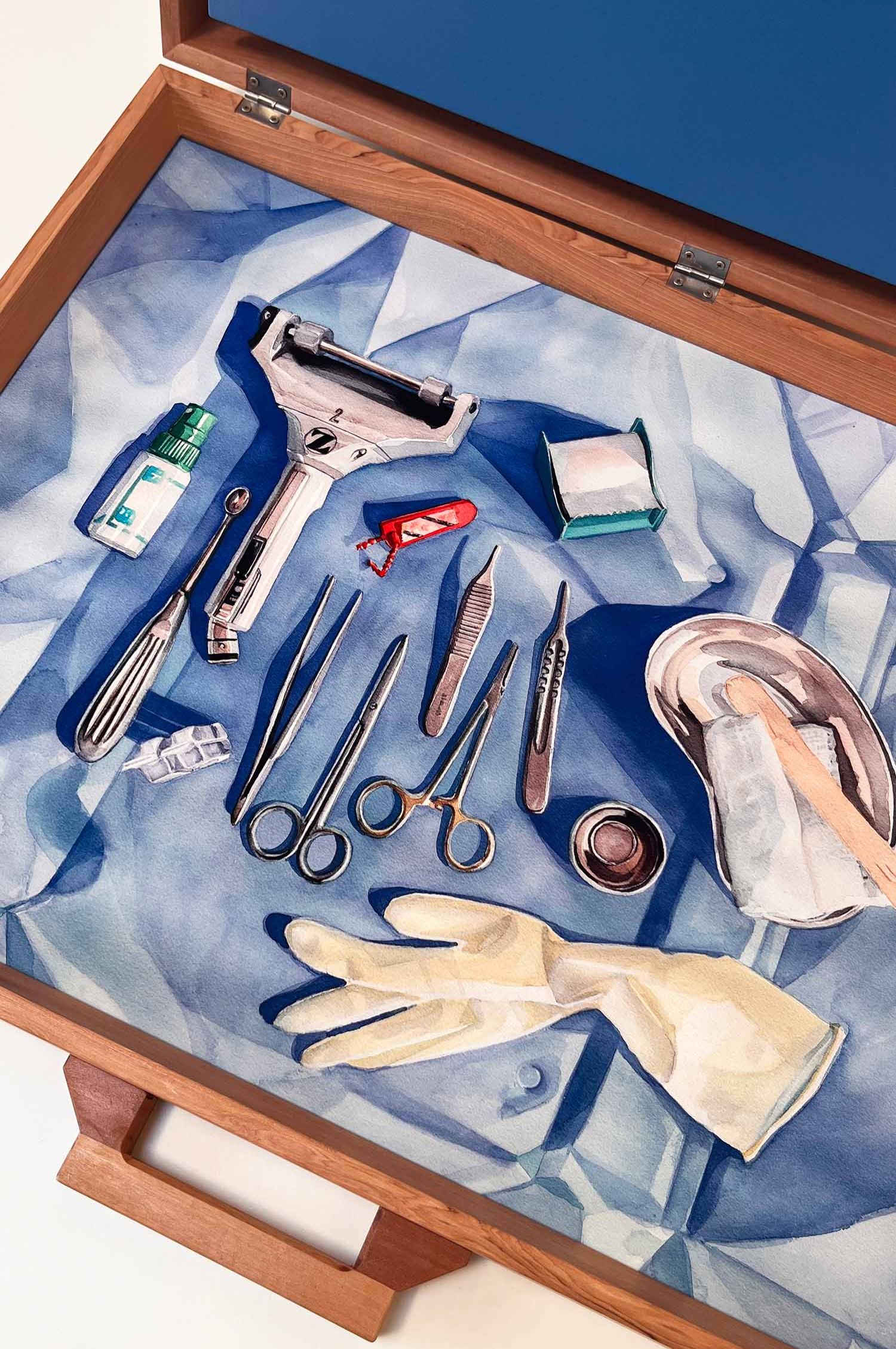
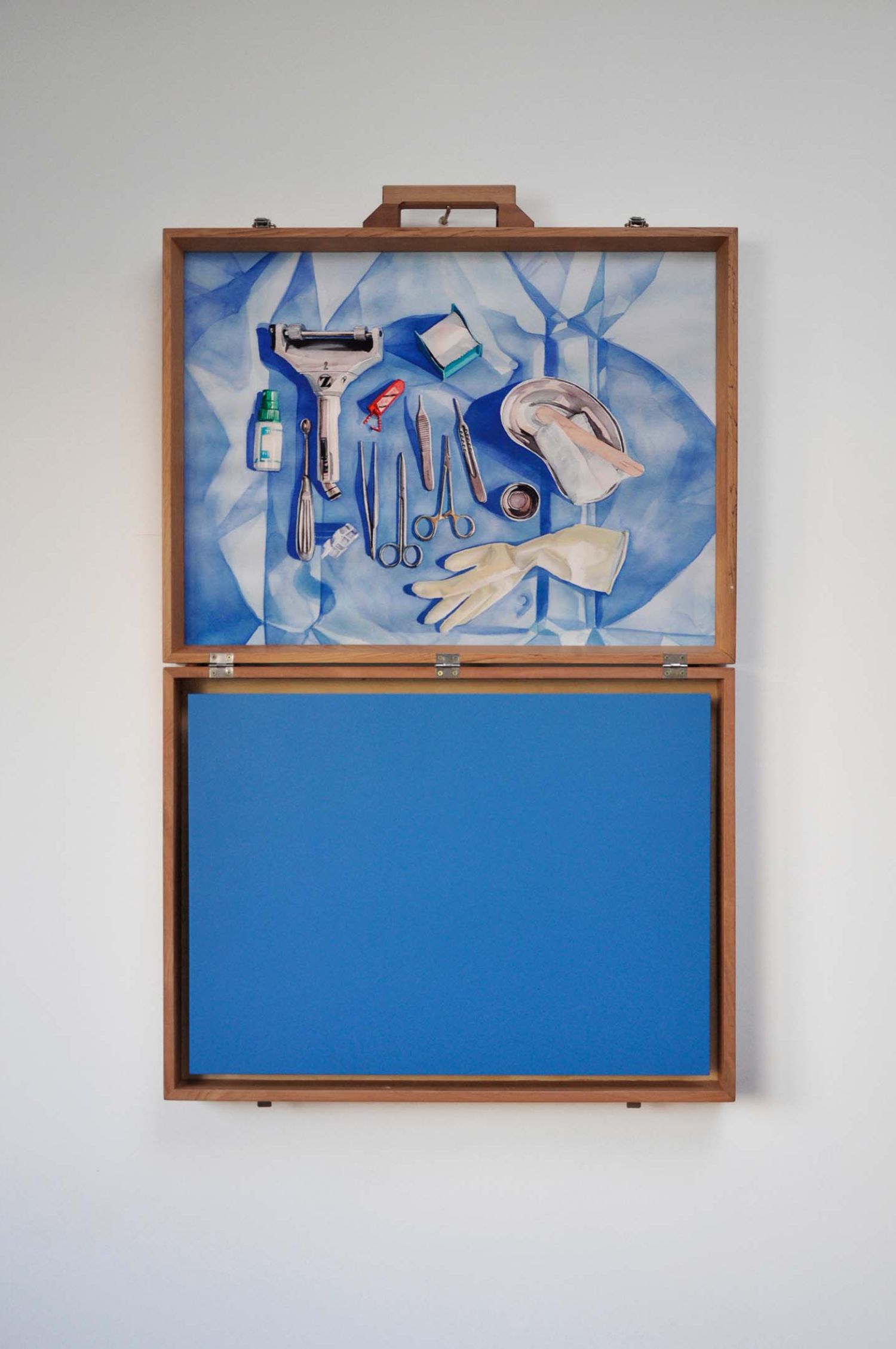
Maletín de madera con impresión Giclée (original en acuarela) y voz de Sebastián Villegas, San Miguel. Tamaño 61 x 47 x 10 cms.
CHIRURG
Was mich am meisten bewegt, ist, das Geheimnis hinter einer Diagnose zu lösen, aber nicht nur wegen der intellektuellen Herausforderung – die schon interessant ist – sondern wegen der Möglichkeit, jemandem zu helfen und es direkt zu sehen. Und in der Chirurgie, im Gegensatz zu anderen Fachgebieten, sieht man das Ergebnis sehr bald, sagen wir, in ein paar Tagen. Für mich ist es auch klar, dass ich denen helfen möchte, die leiden. Und die komplizierteren Patienten die Traumatisierten, die Verbrannten, vor allem Kinder, die am empfindlichsten sind. Das hat für mich eine besondere Konnotation.
Mein Spezialgebiet sind Verbrennungspatienten, und dabei ist eines der Dinge, die ich am attraktivsten finde, die Behandlung der Folgen von Verbrennungen, die letztendlich die Narben sind, die die erste Behandlung der Verbrennung hinterlassen hat. Es gibt Patienten, die wir selbst behandelt haben, oder andere, die von anderswoher kommen, aber das entscheidende ist, dass diese Narbenhaut sehr wenig Elastizität hat und oft Bewegungseinschränkungen oder funktionelle Alterationen hinterlassen kann. Wenn man diese Patienten behandelt, wird man zu einer Art Narbenarchäologe. Es ist eine schwierige Haut, man muss kleine Bewegungen machen, die Position und Richtung des Skalpells ändern und so werden die erzeugten Spannungen beeinflusst. In gewisser Weise wird alles getan, um die Spannung zu lösen, die diese Narben haben. Und damit entfaltet sich die Funktionalität des Kindes. So kann ein Kind, was seine Hand nicht aufmachen kann, nach einer einstündigen Operation wieder seine Hand öffnen. Und das ist wirklich ermutigend. Die Patienten sind sehr dankbar und deshalb bekomme ich auch ab und zu ein kleines Geschenk.
Dieses große Gerät hier wird Dermatom genannt. Das Dermatom ist das Gerät, mit dem man die Hauttransplantate, diese sehr dünnen Hautstücke, herausnehmen kann. An der Seite hat es eine Art Skala, an der man ablesen kann, wie dick die Haut ist, die man entnimmt. Eines der Dinge, die ich mit diesem kleinen Gerät gelernt habe, ist, dass die Skala in Wahrheit gar nicht so wichtig ist, denn es gibt so viele Faktoren, so viele Variablen, die den Prozess der Hautentfernung zu einem Handwerk machen. Das wesentliche bei der Hautentfernung ist, dass bei einem Patienten mit einem großen Deckungsdefekt oder einer großen Verbrennung, ist es eben diese Haut, die ihm das Leben retten wird. Deshalb mag ich ihn sehr gern, denn er ist wie mein Partner, mit dem wir viele Patienten gerettet haben. Dieser hier ist seit 2012 bei mir, und mein Vater hat einen, der anscheinend in der Klinik verloren gegangen ist, der war ein Jahr jünger als ich, manche von uns nennen ihn meinen kleinen Bruder, aber naja…
Hier haben wir die Schere, sie ist ein toller Begleiter, aber auch ein bisschen tückisch, weil sie gerne stumpf werden, vor allem, wenn sie beim Sterilisieren schlecht behandelt werden. Aber es gibt eine, die ich liebe. Diese, ich nenne sie „die Köstliche“, weil sie nie ihre Schärfe verloren und mich bei den kompliziertesten Operationen begleitet hat und es immer gut ausgegangen ist. Als wir von einem Krankenhaus in das neue Gebäude umgezogen sind, hatte ich die Möglichkeit, all diese Instrumente selbst auszuwählen, so dass sie speziell für die Arbeit in der Einheit für plastische Chirurgie bei Verbrennungen geeignet sind. Hier gibt es eine lange Pinzette, diese wird normalerweise verwendet, um in tieferen Bereichen zu operieren, deshalb ist sie länger. Ich benutze sie jedoch, um an der Oberfläche zu operieren, zum Transplantieren. Denn als ich anfing mit meinem Vater zu arbeiten, gab es nur eine kurze und eine lange Pinzette in der Schachtel. Also benutzte mein Vater die kurze, die er immer benutzt hatte, und ich musste die lange benutzen, die ich auch heute noch benutze. Und jeder weiß, dass das meine Pinzette ist.
Ich arbeite schon sehr lange mit meinem Vater zusammen, ich glaube, seit 2006. Eigentlich arbeite ich die Hälfte der Zeit mit ihm zusammen, denn jeden Morgen bin ich in meinem Krankenhaus mit dem Team von dort und nachmittags arbeiten wir zusammen. Mein Vater ist eine sehr wichtige Person für mich. Er war mein Lehrer. Beim Erlernen des Spezialgebiets der Verbrennungschirurgie, da es keine formelle Ausbildung ist, erinnerte es stark an einen mittelalterlichen Meister, denn ich lernte von ihm. Und für mich war es eine große Gelegenheit, denn er gilt als einer der besten in seinem Feld. Das ist der emotionale und handwerkliche Teil des Berufs. Und es war ein gegenseitiger Lernprozess, so komplex wie alle Beziehungen sind. Wir hatten unsere Höhen und Tiefen. Immer mit sehr großen Ansprüchen an uns selbst, aber auch mit dem Gefühl, dass wir ein sehr gutes Team sind, bei der Behandlung unserer Patienten. Das ist der Vorteil, und andererseits hat ihn vielleicht die Tatsache, dass ich sein Sohn bin, anspruchsvoller gemacht als mit anderen Studenten, und habe deswegen mehr Zeit gebraucht, einige Dinge zu entwickeln. Die berufliche Adoleszenz hat länger gedauert, aber ich denke, dass ich was das essenzielle Lernen angeht in diesem Fachgebiet, auf einem guten Weg bin. Und wir haben eine großartige Zeit zusammen.
Ich war immer dankbar dafür, dass mein Vater mich ausgebildet hat, nicht nur für den technischen Aspekt, sondern auch, um von seiner Art, Patienten zu betrachten und wie er mit komplexen Fällen umgeht, zu lernen. Seine Methode, eine Hypothese zu erstellen, im Grunde die wissenschaftliche Methode, Ich glaube, das war früher viel selbstverständlicher. Heutzutage fühlen sich junge Menschen nackt, wenn sie kein Handy haben, als würden sie nicht existieren. Es gibt viel weniger Toleranz für Ungewissheit und empirische Erfahrung. Und ich glaube, dass die Chirurgie eine Kunst ist, eine Disziplin. Wenn man eine Disziplin hat, muss man natürlich studieren, und zwar sehr viel, und man muss üben. Wie ich schon sagte: Übung macht den Meister. Und jedes Mal, wenn man mehr und mehr Schwierigkeiten hinzufügt, erreicht man die Beherrschung. Es ist letztlich ein Beruf. Ich denke, das ist viel näher an Herrn Miyagui als ChatGPT.
Eine Sache, die ich an Verbrennungspatienten besonders mag, ist die Herausforderung, denn im Gegensatz zu anderen Pathologien ist dies nicht durch eine einzige Operation zu lösen, wie eine Gallenblase oder eine Blinddarmentzündung, die keine Komplikationen hat. Diese Patienten erfordern wiederholte Aufnahmen auf der Station, insbesondere wenn es sich um sehr kritische und komplexe Verbrennungen handelt. Der Plan, den man aufstellt, hat natürlich ein Ziel. Ich sage meinen Patienten immer: „Wir werden von Santiago nach Puerto Montt reisen“. Und sie wissen, dass sie mit dem Bus 13 Stunden nach Puerto Montt brauchen. Was wird auf dem Weg dorthin passieren? Man kann eine Reifenpanne haben oder plötzlich steigt ein Passagier aus, oder man kann einen Unfall auf der Straße haben, es können tausend Dinge passieren. Es gibt viele Faktoren, aber man weiß wenigstens, wie der Weg aussieht. Ich sage den Patienten also, dass ich der Fahrer und der Chauffeur sein werde, und wir werden ankommen, früher oder später, aber wir werden ankommen.
Das ist eine Sache, die aufregend ist, denn plötzlich muss man den Plan anpassen. Und es ist natürlich schön, wenn das Ergebnis positiv ist. Und es ist auch schön, wenn Sachen passieren wie neulich: ein 15-jährige Junge kam mich besuchen, ich kannte ihn, doch ich konnte ihn kaum wieder erkennen. Als er ein Baby war, da hatte er seinen Unfall. Und jetzt ist es so, dass ich ihn nicht mehr behandeln kann, weil er ins Krankenhaus für Erwachsene muss. Und ich hatte das Gefühl, dass ich meinen Abschluss als Arzt mache, weil ich meinen ersten Patienten hatte, der ohne Narben und glücklich in die Erwachsenenwelt eintritt. Diese Entlassung resultiert aus diesem Plan, von dem ich dir erzähle, dass man sich anpassen muss, dass man die Fähigkeit haben muss, sich anzupassen. Und deshalb fragt in der Sicherheitspause die Krankenschwester bei jedem neuen Patienten, der auf die Station kommt: „Was werden wir tun?“ Und wenn es kompliziert ist, sagt man: „Ich weiß es nicht“. Ich glaube ich weiß immer mehr und immer weniger.
THE SURGEON
I’ve been drawing since I was a kid. In fact, we used to draw together sometimes, not often, but sometimes. I drew all the time, and the truth is that when I started studying medicine, obviously I had less time for that hobby, but there were times when I had a little more freedom and, inevitably, drawing came back. And so it has been coming in and out of my life. Probably when I have more time and I am more relaxed, I draw more, and when I don’t, I’m working. Now, I’ve realized that this last years this passion for drawing has returned and I’m drawing fairly regularly, and what struck me is that I feel much more precise when operating. I think I’m developing more proprioception. I’ve always worked with my hands, they’re my main tools. I imagine that’s why I went into plastic surgery. Treating my patients is also a bit like sculpting or making plasticine figures with your children, because in a way you have to think spatially. Thinking in 3D, moving things here or there, all inside your head. It’s what they call spatial intelligence. And as you repeat it, you develop that skill faster and faster.
What really moves me is to solve the mystery which is behind a diagnosis. But not only because of intellectual challenge -which is already interesting- but to be able to help somebody directly. You see the results right there. And in surgery, unlike other specialities, you can see them very quickly, in a matter of days. And well, for me it’s also evident that I want to help those who are suffering, and the most complex patients, those who are traumatised, burned, especially children, who are the most vulnerable, and for me that has a special meaning.
My main speciality is burn patients, and within that, one of the things I find most appealing is treating the after-effects of burns, which are usually the scars left behind by the initial treatment. We have treated some patients ourselves and others have come to us from elsewhere, but the important thing is that this kind of scar tissue has very little elasticity and can often limit the movements or cause functional problems. So when you see this patient, you become a kind of archaeologist of scars. It is difficult skin to work on, and the truth is that you have to make small movements, changing positions and directions with the scalpel, altering the tensions that arise. In a way, everything is done to release the tension in those scars, and with that, the child’s functionality is restored. So, in one-hour surgery on a little hand, a child who couldn’t open their hand can now do so. And that’s really rewarding. The patients are very grateful, and that’s why I often receive little gifts.
This large device here is called a dermatome. The dermatome is the equipment that allows you to remove skin grafts, these very thin layers of skin. On the side, it has a kind of scale that lets you know how thick the skin you are removing is. One of the things I’ve learned with this little device is that the precise mesurement doesn’t really matter, because the truth is that it’s so multifactorial, it has so many variables, that it makes skin removal a bit of very skilled craft. The important thing about removing skin is that, clearly, in a patient who has a large skin defect or a severe burn, it is that skin that is going to save his life. So I’m very fond of it, because it’s like my partner with whom I’ve rescued many patients. I’ve had the one I have here since 2012, and my dad had one that seems to have been lost in the clinic, which was a year younger than me. So some of us call it “my little brother”.
Here are the scissors. They are great tools, but they can also be a bit deceitful because they quickly lose their sharpness, especially when they are treated poorly during sterilization. But there is one that I love the most, this one here. I call it ‘the delicious one’ because it has never lost its sharp edges, it has accompanied me in the most complex surgeries and has always performed well. When we moved from the old hospital to the new building, I had the opportunity to select all these instruments myself, so they are designed specifically for the work we do in the Plastic Burns Unit at this hospital. Here is a long pair of tweezers, which is usually used for deep surgery, which is why it is a longer tool. However, I use it for surface surgery for grafting, because when we started working with my father, there was only one short pair of tweezers and one long pair in the box, so my father used the short ones he had always used, and I had to use the long ones, which are the ones I still use today. And now everyone knows that those are mine.
I have been working with my father for a long time, I think we have been working together since2006. And the truth is that I work with him half the time, because every morning I am at the hospital with my team there and in the afternoons we work together. Now, my father is a very important figure for me, he has been my teacher and in this learning process of the burn speciality, which is not a formal speciality, I can see a lot of a medieval master in the sense that I’ve been learning from him, and the truth is that for me it was a great opportunity because he’s considered one of the best in this field and, therefore, it has been at the same time the most emotional and artisanal dimension of learning this trade. And it’s been a mutual learning experience, complex like all relationships. We’ve had our ups and downs. He’s always very demanding, but I also feel that we make a very good team in treating our patients. Now, of course, that’s the advantage, but on the other hand, the fact that I am his son may have made him more demanding than with other students, and that has meant that I have taken longer to develop some things. It’s like my professional adolescence has been longer, but the truth is that in terms of deeper learning, I think I’m well on my way in this speciality and we have a great time together.
Now, I thank he has trained me technically. But above all, you learn from his gaze how you face the cases, what you ask yourself. Because the method of generating an hypothesis was clearer times ago. Today, for young people if something isn’t in the cell phone it doesn’t exist. There is much less empirical experience and this is worrying because surgery is an Art. It’s a discipline you have to study, to practice, to repeat, adding difficulty to achieve mastery. It’s like a job. It’s much nearer Mr. Miyagui than the chat GPT.
I have always been grateful to my father’s training, not only for the technical aspects but also for learning from his perspective, how he deals with patients and complex cases. He has this method of generating a hypothesis, basically the scientific method, which I feel was much clearer before. Nowadays, young people feel helpless without their mobile phones, as if reality doesn’t exist. There is much less tolerance for uncertainty and empirical experience, and I believe that surgery is an art, a discipline. Obviously, you have to study, and you have to study a lot. You have to practise. As I said, repetition makes perfect. And each time you should add more difficulty to the task to achieve mastery, so it ultimately becomes like a craft. I think this discipline seems much closer to Mr Miyagui than to ChatGPT.
One thing I really like about burn patients in particular is the challenge, because unlike other medical conditions, this isn’t resolved with a single surgery, such as an uncomplicated gallbladder or appendicitis. These patients need to go into surgery again and again, especially if they are more critically burned and in complex cases. The plan you draw up has a goal, of course. I always tell my patients, ‘We’re going to travel from Santiago to Puerto Montt.’ And you know that by bus you could get there in 13 hours. What’s going to happen along the way? If you get a flat tyre or suddenly a passenger gets off at another stop, you could have an accident on the road, thousands of things could happen, there are many factors, but at least you know the route. So I tell my patients that I’m going to be the driver and we’re going to get there, sooner or later, but we’re going to get there. That’s exciting because sometimes you have to adjust the plan because of these things. And it’s nice when, the outcome is still positive. And it’s also nice when, for example, the other day a 15-year-old boy came to see me, whom I hardly recognised because I met him when he was a baby, when he had his accident. And of course, now I can’t treat him anymore because he has to go to the adults hospital, and I felt like I was graduating as a doctor because I had my first patient entering the adult world happily and without any scars left. Now, that recovery finally turns out to be part of this plan I’m telling you about, that you have to keep adjusting, you have to be able to adapt. And that’s why when you enter the operating room with a new patient, the nurse always asks you during the safety break, ‘What are we going to do?’ And when it’s a complex case, you say, ‘I don’t know.’ So I realize that the more I really know, the more I say I don´t.